Free Borrowing: Next stop for securities-based lending?


New In-Depth report by Copper Research
The hype around DeFi may have waned over the past year, however there are some outliers that could prove to give the ecosystem a second-coming.
In this In-Depth, Copper looks at some of the collateral-based protocols that could begin to pave the way to a much more interesting financial system in the long-term. Against non-volatile tokenised assets, easy access to interest-free borrowing may potentially set a new global standard...
Decentralised Finance and protocol rulesets can be (and have
been) developed to extract as much value as possible in the most
convoluted of approaches. But there are some protocols that
keep things simple, as they ultimately should be, in order to appeal
to a broader audience.
Although the hype around DeFi has waned significantly over the
past year, there are some outliers that could prove to give the
ecosystem a second-coming. In this In-Depth, Copper looks
at some of the collateral-based protocols that could begin to
pave the way to a much more interesting financial system in the
long-term. Against non-volatile tokenised assets,
easy access to interest-free borrowing may potentially set a new global standard.
Anyone immersed in this space understands well that assets
are heading into digital format. Whether tokenized securities or
NFT representations of real estate, the opportunities for capital
efficiency are emerging out of DeFi.
For now, collateral based lending will have to deal with
cryptocurrency market whims that fluctuate greatly.
It would be difficult, although not impossible given the blockchain,
to prove that current DeFi usage of borrowing and lending isn’t
predominantly a leverage tool. It more than likely for the most part
is just that. But the understanding of investing and leverage is
becoming a much more popular topic.
Buy, borrow, die
While this research team would love to take credit for ‘Buy,
borrow, die’, this was in fact the headline of an article out of the
Wall Street Journal last year that discussed how wealthy clients
are increasingly using their investment portfolio to borrow at low
interest rates.
And while the continued ingenuity of crypto developers can be
applauded, a great deal of the current financial system has been
ported onto the blockchain. In the crypto ecosystem, there are
now several projects in DeFi that are offering perpetual interest-
free collateral loans. Same, same but different.
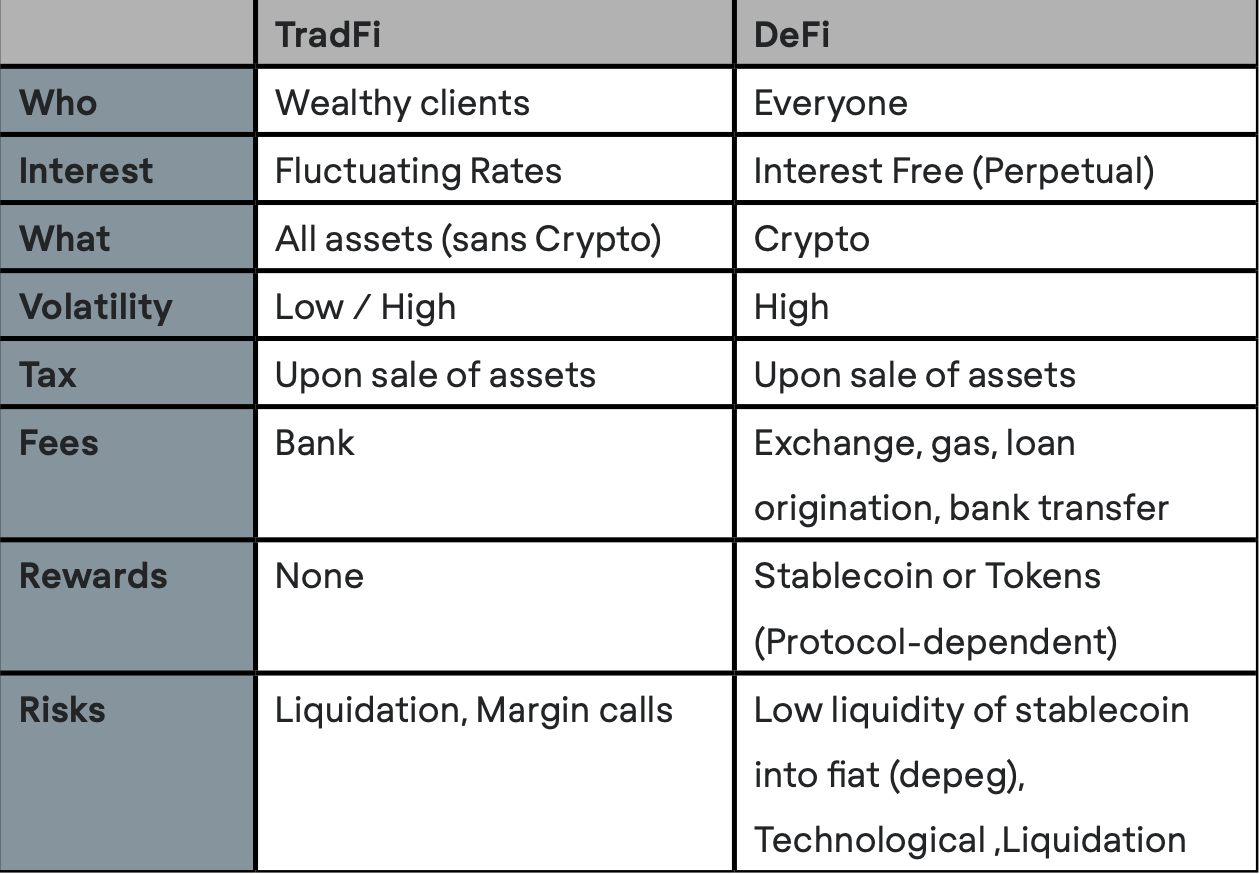
There are a few keywords to highlight from the paragraph above
which allows for a very simple breakdown (see table).

Buy, borrow, and hope you don’t getliquidated
As the ecosystem grows across multiple chains, so are the
products replicated on each network. Some of the interest-free
borrowing platforms include Liquity (Ethereum), QiDao (Multi-
Chain), Hedge (Solana), Yeti (Avalanche) and Zero (Sovryn).
Copper estimates that there is currently well over $250mn in
outstanding loans across these protocols. Collateral value is
already in the billions. However, these platforms have gained little
attention. While there are plenty of problems that need ironing
out, tied with US equity products will certainly increase eyes on
tokenised-Securities-Based Lending (tSBL).
Will the real USD please stand-up?
Every time a loan is originated on any of these platforms,
the token received by the borrower will be a dollar-pegged
cryptocurrency that the platform itself issues. There is a different
stablecoin for each platform.
The reality is that as it stands, off-ramping these tokens back into
the banking system to spend outside of what is available in the
crypto ecosystem is difficult at best.
For starters, there are few direct routes to conversion into
bankable deposits. And depending on the size of the loan, and the
issued dollar-pegged token, neither liquidity, nor equal conversion
stand to the test.
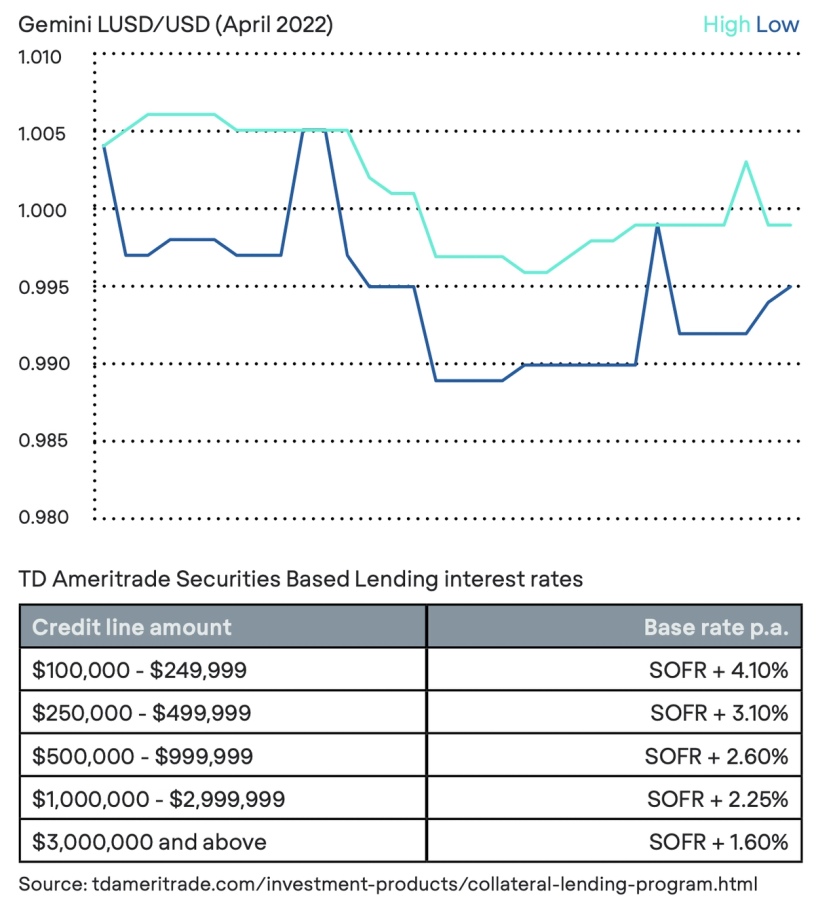
Liquity’s LUSD for example, the largest interest-free protocol,
does have a market pair into USD on US exchange Gemini which
was only actually listed last month. As it stands, market depth is
near non-existent, and the peg doesn’t really hold up (see chart).
Of course, this is the current status. Increased use will ultimately
iron out these specific issues as was the case with Maker’s DAI
when first launched. A depegged USD offers an opportunity to
pay back a loan at a discount. These arbitrage opportunities will
likely find bots taking advantage as demand grows.
Regardless, there are other routes to exchange into other liquid
stablecoins on DeFi protocols that have deep enough volumes
before off-ramping. Executed swaps on Uniswap prove that much.
Stacking cents
Interest is one thing, but fees in crypto transaction can add up
very quickly. From on-ramping into an exchange to begin the
process, and off-ramping back into fiat, there would be a minimum
of nine steps and fees at every stage. Back of the envelope
calculations show that fees would be around 3% in total, one-off.
Even with these costs, the perpetual interest free loan would still
be much more favourable than what is currently being played out
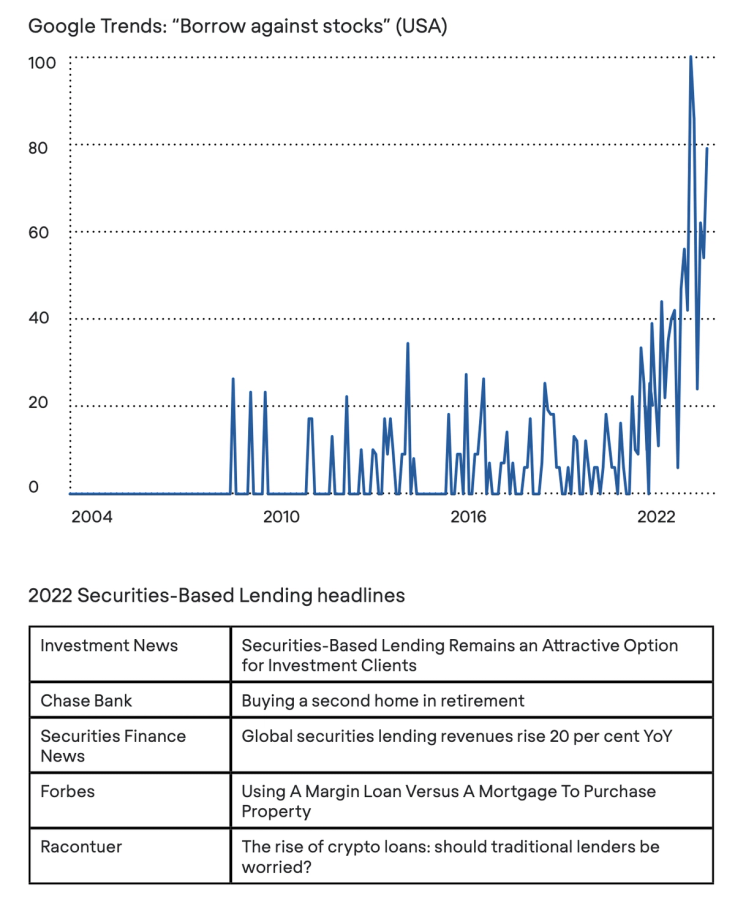
in traditional markets starting at over 4% per annum (see table).
Protocol valuations
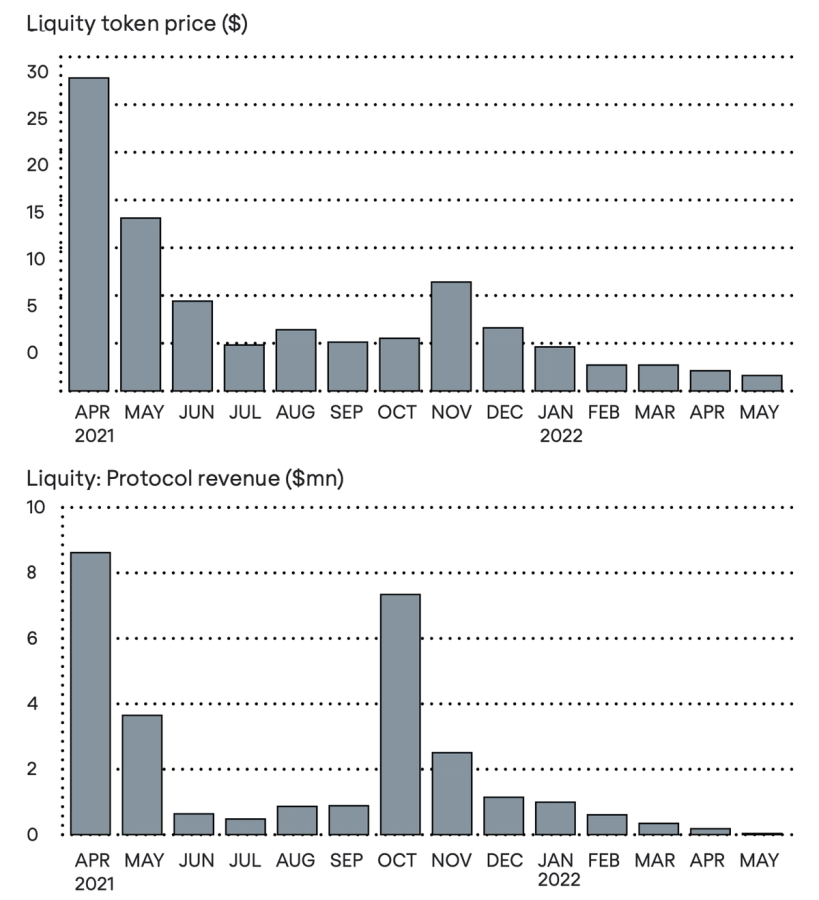
While we’ve discussed the use-case of these protocols, it would
be remiss of us to not mention the platform valuation has taken a
good beating (see chart).
With that said, Liquidy has moved into full decentralization
(excluding nuances of the Ethereum dependency points). Token
holders of LQTY earn a portion of the fee revenues that have
rolled in just north of $28mn, which for a one-year old platform is
nothing to scoff at. Its fully-diluted market cap stands at $180mn.
On the other side, Hedge, which promises much of the very
same on the Solana blockchain just secured a $3.7mn round from
reputable investors only last month. The idea clearly has insiders
interested (pun-intended).
This report however is not assessing the platform valuation. We
are however highlighting the potential of what these platforms
can do. The idea of interest free loans against collateral is here,
which will likely prove a much more interesting seed than protocol
valuations. And for good reason, as we assess below.


Close, and yet far...
Efforts on the blockchain to tokenise stocks have for better lack
of words failed quite miserably. Last year Uniswap, the largest
decentralised exchange, was forced to remove synthetic versions
of US equities off the platform as the SEC swooped in against the
Brooklyn-based outfit.
And the Mirror protocol that also tokenises equities is currently
seeing premiums versus the oracle price as high as 30% on some
tokenized stocks.
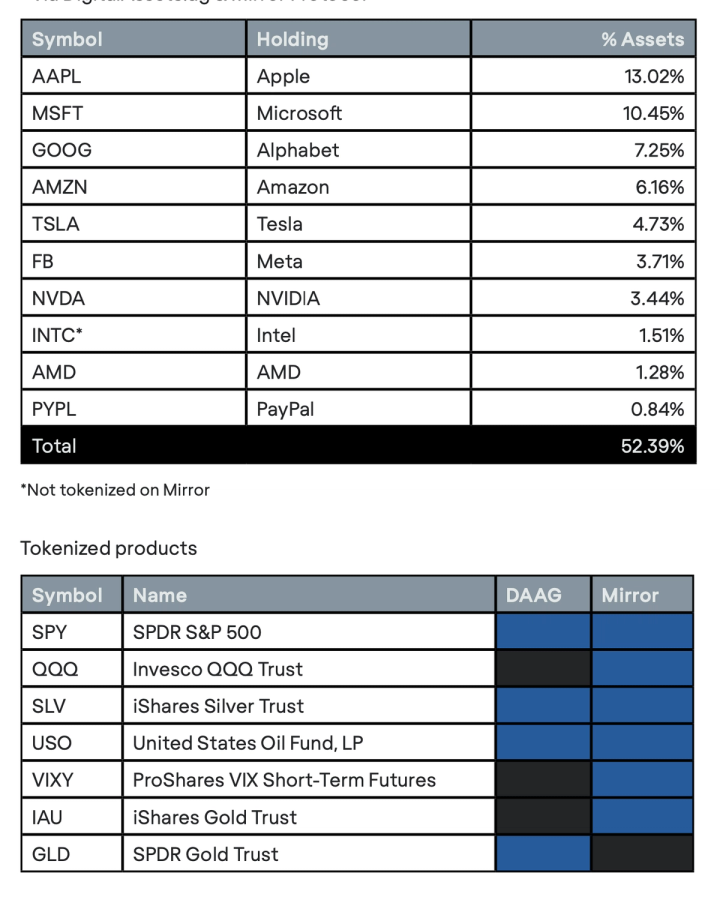
But then again, there is a middle ground, of sorts. FTX has
tokenised stocks and some ETFs trading on their platform through
licensed issuer DAAG. The tokenised stock issuer has $100mn
AuM since its initial rollout less than a year ago.
Unlike synthetics, these tokenised stocks do pay out dividends.
These assets are transferable on the Solana blockchain. And the
potential of these tokenised equities being wrapped and ported
into other chains is very plausible.
It’s not hard then to imagine how these token representations,
which do have a licensed broker behind them and met KYC
requirements can find their way as collateral on DeFi protocols in
the not so far future.
Trend to zero
It seems inevitable that these open-source protocols continue
to be replicated with one platform eventually figuring out the
incentive dynamics and offer a near 0% origination fee.
Still, realistically speaking, mass adoption of tSBL requires a great
deal more than education on the risks of liquidation be it crypto or
otherwise. But the real potential isn’t in what we’re seeing today
at all.
MicroStrategy borrowed money on Bitcoin collateral. Goldman
Sachs tested the waters with Coinbase. The viability of tokenised
assets being used as collateral is now without a shadow of a
doubt reached a viable product offering.
What needs to be resolved is the user experience that requires
quite a bit of blockchain knowledge and financial education.
And friction will likely remain as a better transaction flow will be
dependent on the custodial and fiat ramping infrastructure.
But the potential of perpetual interest-free loans against non-
volatile traditional assets is just around the corner. Wealth
management capital efficiency has arrived to the people. Not only
with much better terms, but immediate access. And access is key
Over 50% of QQQ composition (Nasdaq100) already tokenized
- via DigitalAssets.ag & Mirror Protocol


Disclaimer
THE INFORMATION CONTAINED WITHIN THIS COMMUNICATION IS FOR INSTITUTIONAL CLIENTS (BOTH EXISTING AND
PROSPECTIVE) THE VALUE OF DIGITAL ASSETS MAY GO DOWN AND YOUR CAPITAL AND ASSETS MAY BE AT RISK.
Copper Technologies (UK) Ltd is a crypto asset custodian where clients entrusts crypto assets with Copper. Where we make any
transfer of your crypto assets we will always do so on your instruction. Copper does not recommend that any crypto asset should be
bought, sold, or held by you. Trading crypto assets carries a high level of risk, and may not be suitable for everyone. Before deciding to
trade crypto assets you should carefully consider your financial objectives, level of experience and risk appetite. The possibility exists
that you could sustain a loss of some or all of your initial capital and therefore you should be aware of all the risks associated with crypto
asset trading and seek advice from a suitably qualified independent financial adviser.
Copper makes no representation or warranty in relation to the accuracy of the information contained herein.
Any opinions, news, research, analyses, prices, or other information contained in these materials is provided as general market
commentary, and does not constitute financial advice, trading advice, or any other sort of advice and you should not treat any of the
information in the communication as such.
While Copper holds a temporary registration with the FCA for anti-money laundering purposes, neither Copper nor the products or
services which we offer are regulated by the FCA. Therefore, you will not benefit from the regulatory protections that are available in
respect of regulated services offered by regulated firms.
Copper products and services are not covered by the Financial Services Compensation Scheme and you will not be eligible to refer any
complaint relating to these to the Financial Ombudsman Service.
This communication is neither directed at nor intended for clients based in the USA.